
By Ramdoot Pydipaty
It’s 11 PM. A claims adjuster is staring at three different system logins, toggling between a patient’s medical history, a stack of unstructured claim documents, and a risk assessment tool that seems to have a mind of its own. Sound familiar?
This is the quiet crisis playing out across insurance and legal organizations every day. Not dramatic enough to make headlines, but costly enough to slow everything down. The culprit isn’t a lack of data. It’s too much of it, poorly connected, and nearly impossible to navigate at speed.
The Breaking Point
Modern claims management sits at an uncomfortable intersection: mountains of complex, unstructured data on one side, and the urgent need for fast, accurate decisions on the other. Traditional chatbots were supposed to bridge this gap. Instead, they delivered half-answers, misread context, and left adjusters doing the heavy lifting anyway.
Something had to give.
Meet the Team That Changed Everything
The solution wasn’t another chatbot. It was a rethink of the entire architecture, built around a Conversational Agent at the center, surrounded by a squad of highly specialized supporting agents. Think of it less like software, and more like walking into an office full of the world’s best insurance specialists, all available instantly, all working together seamlessly.
The Conversational Agent is the one who greets you at the door. It reads your natural language query, understands your session context, and knows exactly which specialist in the room can best answer your question. It doesn’t guess. It orchestrates.
The Specialists in the Room
Once the Conversational Agent understands what you need, it hands off to the right expert:

Summaries & Report Search Agent. Ask it for a summary or analysis report from a pile of claim documents, and it returns highly accurate results in milliseconds. This isn’t keyword matching. It’s built on Doclens’s proprietary process grounded in deep domain understanding and contextual reasoning at scale.
Medical Summaries Agent. Complex medical records are its native language. It condenses a patient’s entire claims-related medical history into clean, digestible summaries, instantly, and without losing the nuance that matters in a claim.
Claim Summaries Agent. Demands, negotiations, settlement figures. This agent gives adjusters a sharp, consolidated view of where any claim stands across every dimension that counts.
Risk Assessment Agent. Pattern recognition is its superpower. It combs through claim documents, surfaces potential risks, and flags what a human eye might miss under deadline pressure. Data-backed foresight, on demand.
Document Search Agent. Need something specific buried inside indexed documents? This agent retrieves semantically relevant context with precision, not just proximity to keywords.
External Connectivity Agent. Claims don’t live in a vacuum. This agent reaches out to external systems, or complementary internal ones, and brings back what’s needed without forcing the adjuster to context-switch. Access is fully configurable and only enabled when the organization needs it.
Why This Architecture Hits Different
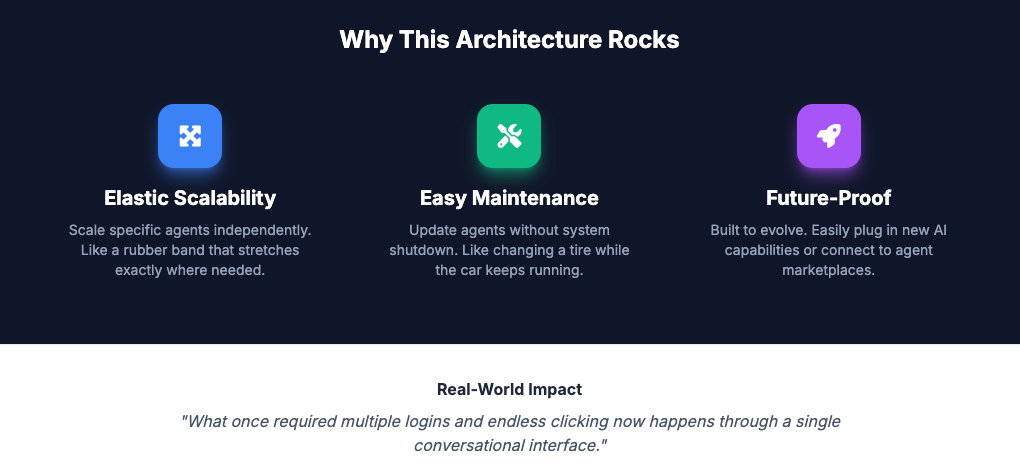
The brilliance of this design isn’t just in what it does. It’s in how it’s built to grow.
When claim volumes spike, scale up the Claims Agent. When search demand surges, give the Search Agent more room to breathe. Each component stretches where pressure is applied, like a system that knows its own weak points before you do.
Updates and improvements happen at the agent level, with no system-wide downtime and no midnight maintenance windows. It’s the equivalent of changing a tire without stopping the car.
And when new AI capabilities emerge, or a new integration becomes valuable, the architecture welcomes them. This isn’t a closed system anxiously protecting its boundaries. It’s a platform built to evolve.
From Hours to Seconds
Picture the old workflow: an adjuster pulls up three tabs, logs into two systems, cross-references a medical file, manually checks claim history, and tries to synthesize a risk profile in their head, all before their next call.
Now picture one conversation. One interface. Every specialist answering in concert, behind the scenes, in seconds.
That’s the shift this architecture delivers. Not just faster answers, but fewer errors, less friction, and claims professionals who can finally spend their time on judgment rather than navigation.
The Bigger Picture
This isn’t a solution built for today’s problems alone. It’s infrastructure for whatever comes next, whether that means new agents, new platforms, or new possibilities in an industry that isn’t slowing down. The claims desk of the future looks a lot less like a stack of open tabs, and a lot more like a conversation.
The key insight: when you give specialists the right tools and a smart coordinator, the whole system becomes greater than the sum of its parts, and the people using it become dramatically more effective.
Comments